Consumer packaged goods (CPG) manufacturers are under increasing pressure to do more with less.
Product portfolios continue to expand. Retailers are requesting more display-ready packaging, variety packs, and promotional formats. At the same time, manufacturers are expected to increase throughput while minimizing labor, reducing downtime, and making the most of available floor space.
Rather than adding standalone equipment for every new requirement, many manufacturers are turning to combination packaging systems that integrate multiple packaging functions into one coordinated solution.
The right combination depends on your products, packaging formats, production goals, and future growth plans.
Here are five of the most common system configurations manufacturers are evaluating in 2026:
Cartoning + Case Packing


For manufacturers packaging cartons into shipping cases, combining cartoning and case packing can simplify product flow while reducing manual handling.
This system is commonly used for:
- Food products
- Personal care products
- Household goods
- Pharmaceutical products
Benefits include:
- Fewer product transfers
- Improved throughput
- Reduced labor
- Simplified line layout
- Better package consistency
Bringing these processes together helps manufacturers eliminate unnecessary transitions while maintaining production speed.
Case Packing + Palletizing


Case packing and palletizing are often two of the most labor-intensive operations at the end of the line.
Integrating these functions allows manufacturers to:
- Reduce manual case handling
- Improve production flow
- Increase throughput
- Improve cube consistency
- Reduce operator intervention
For high-volume production environments, this combination creates a more efficient path from finished product to warehouse.
Retail-Ready Packaging Systems
Retail-ready packaging continues to grow as retailers seek faster shelf stocking and improved product presentation.
Modern systems can automate:
- Display-ready cases
- Club store packaging
- Variety packs
- Promotional packaging
- Mixed-product displays
Rather than relying on manual assembly, manufacturers can produce retail-ready packages at production speeds while improving consistency and reducing labor.

Modular Combination Systems
Not every manufacturer needs a complete packaging line on day one.
Modular systems allow companies to begin with the automation they need today while providing flexibility to expand later.
A modular approach can help manufacturers:
- Add new packaging capabilities over time
- Support increasing SKU counts
- Minimize future disruptions
- Protect automation investments
For growing operations, modularity provides flexibility without requiring a complete line replacement as production needs evolve.

Turnkey End-of-Line Systems
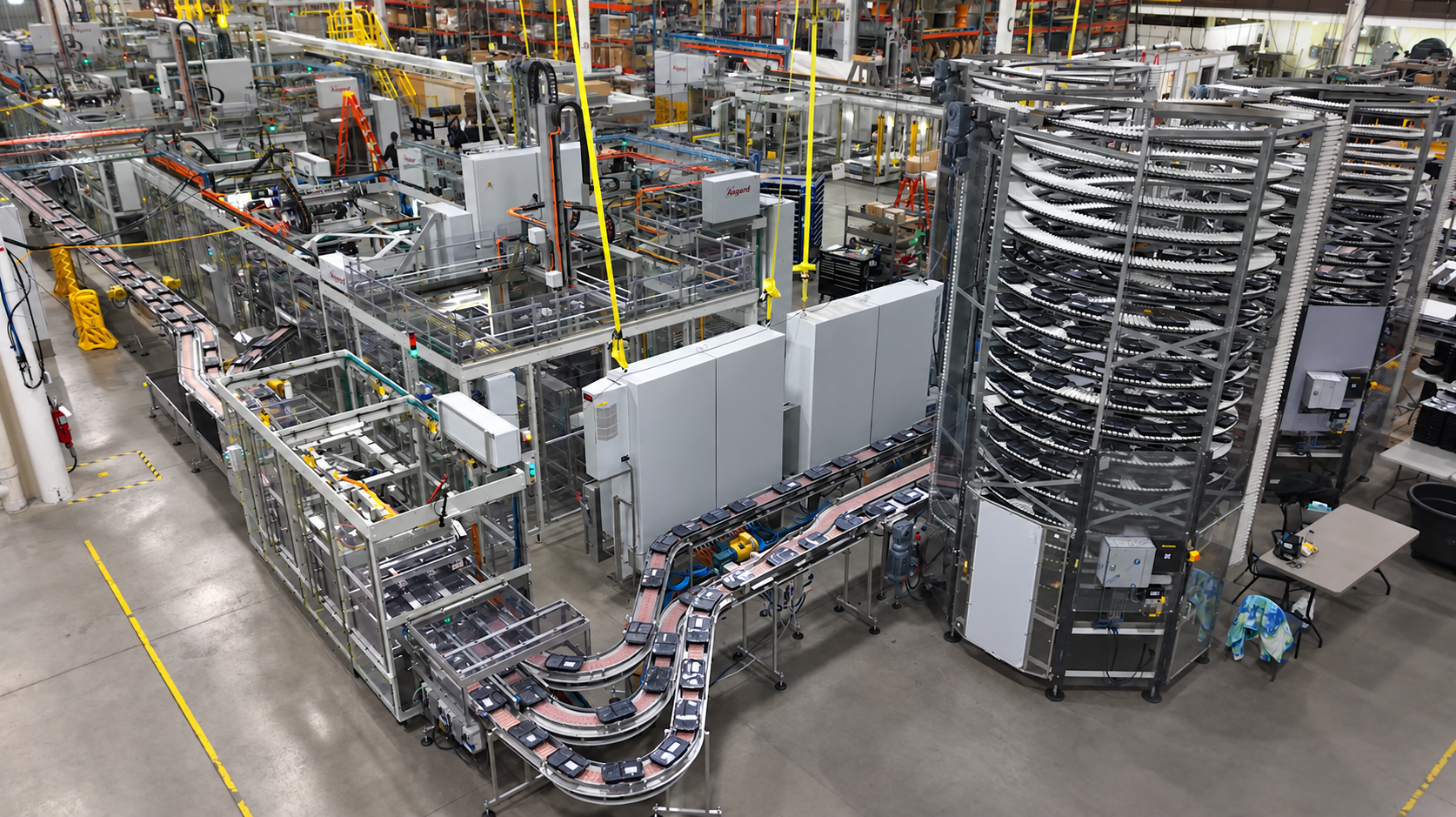
For manufacturers looking to optimize the entire packaging process, turnkey systems provide a fully integrated solution from product infeed through palletizing.
These systems may include:
- Product handling
- Cartoning
- Sleeving
- Case packing
- Robotics
- Vision inspection
- Palletizing
- Conveyor systems
With one coordinated system, manufacturers benefit from streamlined communication between equipment, simplified controls, and improved production efficiency.

Choosing the Right Combination System
No two manufacturing operations are exactly alike.
The right combination depends on factors such as:
- Product characteristics
- Package formats
- Production speeds
- SKU counts
- Changeover frequency
- Available floor space
- Future growth plans
Evaluating these factors early helps ensure your packaging investment supports your operation both today and in the future.
How Aagard Approaches Combination Packaging
At Aagard, we don't believe manufacturers should have to fit their operation around standard equipment.
Our engineering team works with customers to understand their products, production goals, packaging requirements, and long-term plans before designing an integrated packaging solution.
Whether the need is cartoning and case packing, retail-ready packaging, or a fully integrated end-of-line system, our focus is helping manufacturers simplify operations, improve efficiency, and prepare for future growth.

Ready to Evaluate Your Packaging Line?
If you're considering a combination packaging system, our engineers can help identify the right configuration for your products, production goals, and facility.
Contact us today to discuss your application.
Frequently Asked Questions
-
Which packaging machine is right for my facility?
The right packaging equipment depends on your products, package formats, production volumes, available floor space, and future growth plans. Evaluating these factors helps determine the combination of technologies that best supports your operation.
-
Can one machine handle multiple package formats?
Yes. Modern combination packaging systems can run a variety of package styles—including shipping cases, variety packs, retail-ready displays, and mixed-SKU packages—with quick, repeatable changeovers.
-
How do I future-proof my packaging line?
Choose flexible, scalable equipment that can accommodate new products, additional SKUs, changing package formats, and future production growth. Modular system designs can also make future expansion easier.
-
What should I look for in a packaging automation partner?
Look for a partner that takes time to understand your operation, designs solutions around your production goals, provides integration expertise, and offers long-term service and support after installation.
-
How do I eliminate packaging bottlenecks?
Bottlenecks often occur when manual processes or disconnected equipment can't keep pace with production. Integrated combination systems improve product flow by reducing handoffs and coordinating multiple packaging processes.