For years, manufacturers have asked the same question: What would it take to create a truly autonomous packaging operation?
Not a line with fewer operators. Not a machine with more automation. An operation where product enters a facility, moves through packaging, and exits as finished goods with minimal routine human intervention.
For most organizations, that question feels more like a vision than an engineering objective. For one of our customers, it became a design challenge. And for our engineering team, it became an opportunity to rethink nearly every assumption about how packaging operations work. More importantly, it challenged us to think about the entire operation as a connected system rather than a collection of individual machines.
The project began with a deceptively simple objective: What if products could move through an entire packaging operation without routine human contact?
Not just through one machine. Not just through one process. Through the entire operation.
Product enters the facility. Materials arrive when they're needed. Packaging components are prepared automatically. Packaging occurs. Finished goods leave the operation. Throughout that journey, people are only involved when their expertise creates value.
That challenge fundamentally changed how we approached the project.
Instead of asking what equipment we needed to add, we started asking a more important question: Why do people need to intervene in the first place?
Every answer led us toward a different way of thinking about automation:
- Magazine loading.
- Material replenishment.
- Inventory handling.
- Material movement.
- Production recovery.
- Verification.
Historically, these activities have simply been accepted as part of operating a packaging facility. But what if they didn't have to be? That question became the foundation for everything that followed.
The Wrong Question Is: "How Do We Automate This?"
When manufacturers think about automation, the conversation often starts with equipment, a robot, palletizer, AMR, warehouse system, and case packers. But our customer challenged us to think differently. The goal wasn't simply to automate individual processes. The goal was to create an operation where people were only needed to solve problems—not perform repetitive production tasks.
That led us to ask a different question: What causes production to stop?
Because if you can systematically remove those causes, you fundamentally change what's possible. That became the guiding principle behind every engineering decision we made. Every design choice was evaluated through that lens. Would it reduce routine intervention? Would it improve production continuity? Would it make the operation more resilient when real-world conditions inevitably changed?
Instead of asking how to automate another piece of equipment, we began asking how to eliminate the conditions that require human intervention in the first place. That shift in thinking transformed the project from an automation initiative into a systems engineering exercise.
A Decade of Engineering Came Together in One Operation
What's unique about this project is that it wasn't built around a single breakthrough. For more than a decade, Aagard has been developing technologies and capabilities across:
- Material handling
- Inventory management
- RFID tracking
- Packaging automation
- Controls integration
- Material preparation
- Recovery strategies
- Pallet management
Each capability solved specific customer challenges on its own. Looking back, what makes this project unique isn't that it was all new technology. It's that it brought together years of engineering work that previously existed as individual capabilities (and of course some new technology). We’re talking about:
- Material preparation.
- RFID inventory management.
- Packaging automation.
- Controls architecture.
- Recovery strategies.
- Mobile robotics.
- Warehouse integration.
Each solved a different problem. This project became the opportunity to connect those puzzle pieces into one coordinated operation. This isn't a fixed model or a one-size-fits-all machine. It's an integrated approach assembled around a customer's operation where material flow, packaging automation, verification, recovery, inventory management, and end-of-line automation work together as one coordinated system.
Every subsystem was designed with an understanding that its performance would affect every other subsystem. Material movement influences machine utilization. Inventory visibility affects replenishment. Verification impacts recovery. Controls architecture determines how quickly the operation can respond when conditions change.
None of these systems operate independently. That's why we approached the project as a complete operational ecosystem rather than a collection of machines connected together.
The result isn't simply more automation. It's an operation designed to reduce routine intervention while improving continuity, resiliency, visibility, flexibility, and overall production performance. More importantly, it demonstrates what's possible when engineering begins with the operation itself—not the equipment that will eventually fill it.
Product In. Finished Goods Out.
At a high level, the concept appears deceptively simple. Products arrive from upstream production equipment, such as ovens and freezers, while packaging materials and supplies arrive from an automated warehouse environment.
That includes:
- Pallets
- Case blanks
- Sleeve blanks
- Glue and production supplies
But behind that seemingly simple flow is an operation designed to eliminate the routine activities that traditionally consume operators' time.
Before entering production, materials move through automated preparation processes where scrap is removed, pallets are managed, and materials are staged for production. Rather than relying on operators to continually prepare and replenish materials, the system organizes production inputs before they're ever needed.
Case blanks, sleeve blanks, pallets, and production supplies are then delivered automatically throughout the operation as production demands them. Packaging materials arrive prepared for use. Products move from upstream production equipment through packaging, palletizing, and storage systems before ultimately returning to the warehouse environment as finished goods.
Throughout the operation, RFID-enabled tracking and integrated controls maintain inventory visibility while coordinating material movement across the system.
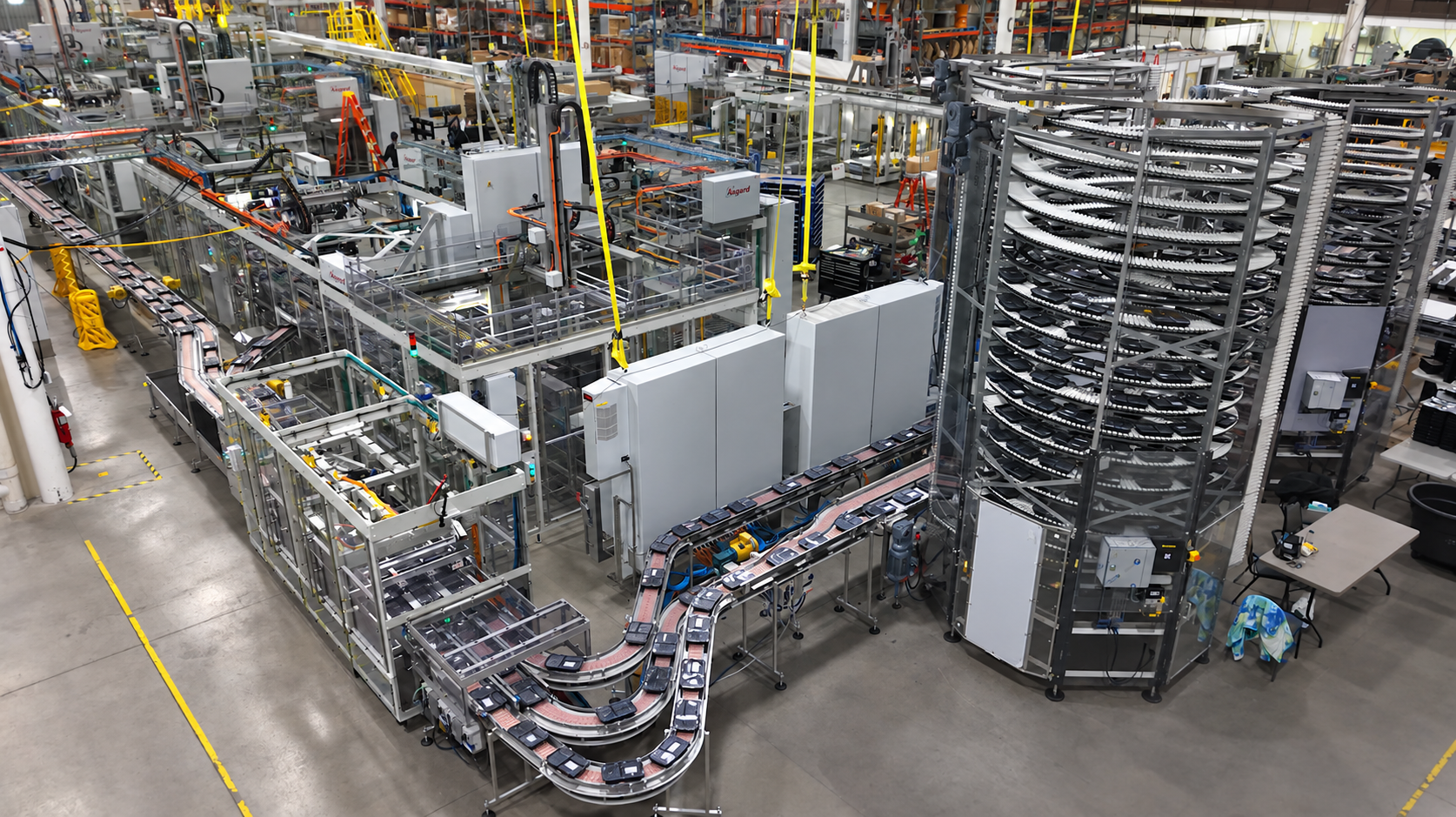
Viewed from above, the operation functions as a closed-loop ecosystem. But the real achievement isn't any individual process. It's the coordination between all of them. Every movement, every handoff, every verification point, and every recovery strategy was engineered to support the operation as a whole—not simply optimize one piece of equipment.
That distinction is important. Many automation projects succeed at improving individual processes. This project was designed to improve the entire operation by allowing every subsystem to work together as one coordinated system.
Why AMRs Became a Critical Part of the Architecture
One of the most significant engineering decisions involved material movement.
The operation handles a wide range of materials—from pallets and case blanks to sleeve blanks and production supplies. Traditionally, supporting that level of material movement would require extensive conveyor infrastructure, numerous transfer points, and fixed transportation paths throughout the facility.
Instead, the system leverages MiR autonomous mobile robots combined with ROEQ Lift & Roll technology.

This architecture allowed us to:
- Reduce conveyor infrastructure
- Minimize transfer points
- Simplify plant layout
- Improve material flow flexibility
- Lower infrastructure costs
Rather than forcing every material through a fixed pathway, the operation can intelligently move materials where they're needed while maintaining coordinated flow throughout the system.
But selecting MiR and ROEQ wasn't simply about choosing autonomous mobile robots. It was about designing an architecture that could reliably function as part of a much larger integrated system. When an operation depends on coordinated material flow across multiple production processes, interoperability becomes just as important as the capabilities of any individual technology.
MiR and ROEQ offered proven interoperability through an established partnership, reducing implementation risk while providing confidence that the material handling architecture would behave as an integrated part of the overall operation—not as a collection of independent technologies. That distinction matters.
Autonomous mobile robots don't create a lights-out operation by themselves. They become valuable when they're integrated into an operation where inventory visibility, production scheduling, packaging automation, and material movement all work together. In this project, AMRs became one component of a much larger engineering strategy focused on maintaining continuous production flow.
The Real Engineering Challenge Was Reliability
Automation is only part of the story. Reliability is the harder problem. Real manufacturing environments are never perfect.
- Materials run low.
- Equipment slows down.
- Products vary.
- Formats change.
- Unexpected events occur.
A truly autonomous operation cannot depend on perfect operating conditions. The engineering challenge wasn't simply how to automate the operation. The engineering challenge was how to keep production moving when reality happens. That philosophy drove many of the architectural decisions behind the system. Rather than designing for ideal conditions, we designed for variability. The operation incorporates:
- Accumulation zones
- Recovery pathways
- Buffering strategies
- Redundancy
- Intelligent controls
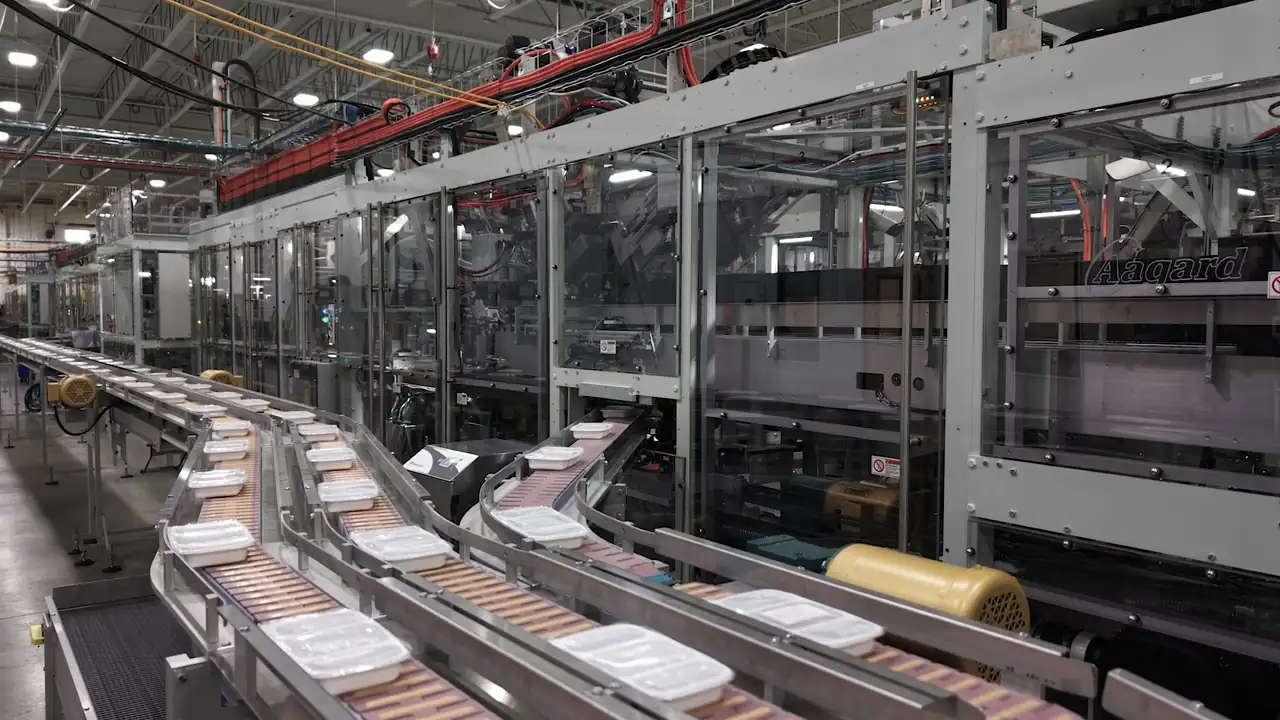
Each element plays a role in maintaining production continuity when operating conditions inevitably change. The system includes three AmbaFlex spirals that provide controlled accumulation and buffering capacity throughout the operation. It also incorporates three sleevers and three case packers that provide both throughput capacity and recovery options when production conditions change. Redundant verification and recovery pathways help maintain production flow even when individual assets require attention.
Instead of designing for perfect operating conditions, we engineered an operation capable of adapting to imperfect ones. Because the objective isn't preventing every disruption. The objective is preventing disruptions from becoming downtime. Small interruptions should never automatically become production stoppages. That philosophy shaped the architecture of the entire operation.
Autonomy Requires Visibility
A fully autonomous operation cannot rely on manual verification. As human touchpoints are reduced, the operation must become increasingly capable of validating itself. That's where traceability becomes a critical part of the architecture. The operation incorporates:
- RFID inventory management
- Barcode verification
- Integrated labeling
- Sleeve laser printing
- Pallet identification
- Forensic camera systems
Together, these technologies provide visibility throughout the operation while improving traceability, validation, troubleshooting, and operational confidence.
The objective isn't simply identifying products. It's ensuring the correct product, packaging, labeling, and inventory information remain synchronized as materials move through production. The less people touch the process, the more important it becomes for the system to know exactly what's happening at every stage.
Visibility isn't simply about collecting data. It's about creating confidence. Confidence that the correct materials are in the correct location. Confidence that packaging components match production requirements. Confidence that inventory remains synchronized. Confidence that when an unexpected event occurs, the system has the information necessary to recover quickly and continue operating.
In highly autonomous operations, visibility becomes just as important as automation itself. Because before a system can make intelligent decisions, it must first understand what's happening throughout the operation.
What Happens When Humans Stop Feeding Machines?
One of the biggest misconceptions about lights-out manufacturing is that it's about removing people. It's not. It's about using people differently.
Manufacturers continue to face increasing complexity, labor constraints, and pressure to improve performance. At the same time, highly skilled employees often spend valuable time performing activities that, while necessary, contribute little to the unique value those individuals can provide.
They spend time:
- Moving materials
- Loading magazines
- Handling replenishment
- Managing inventory movement
- Supporting repetitive production tasks
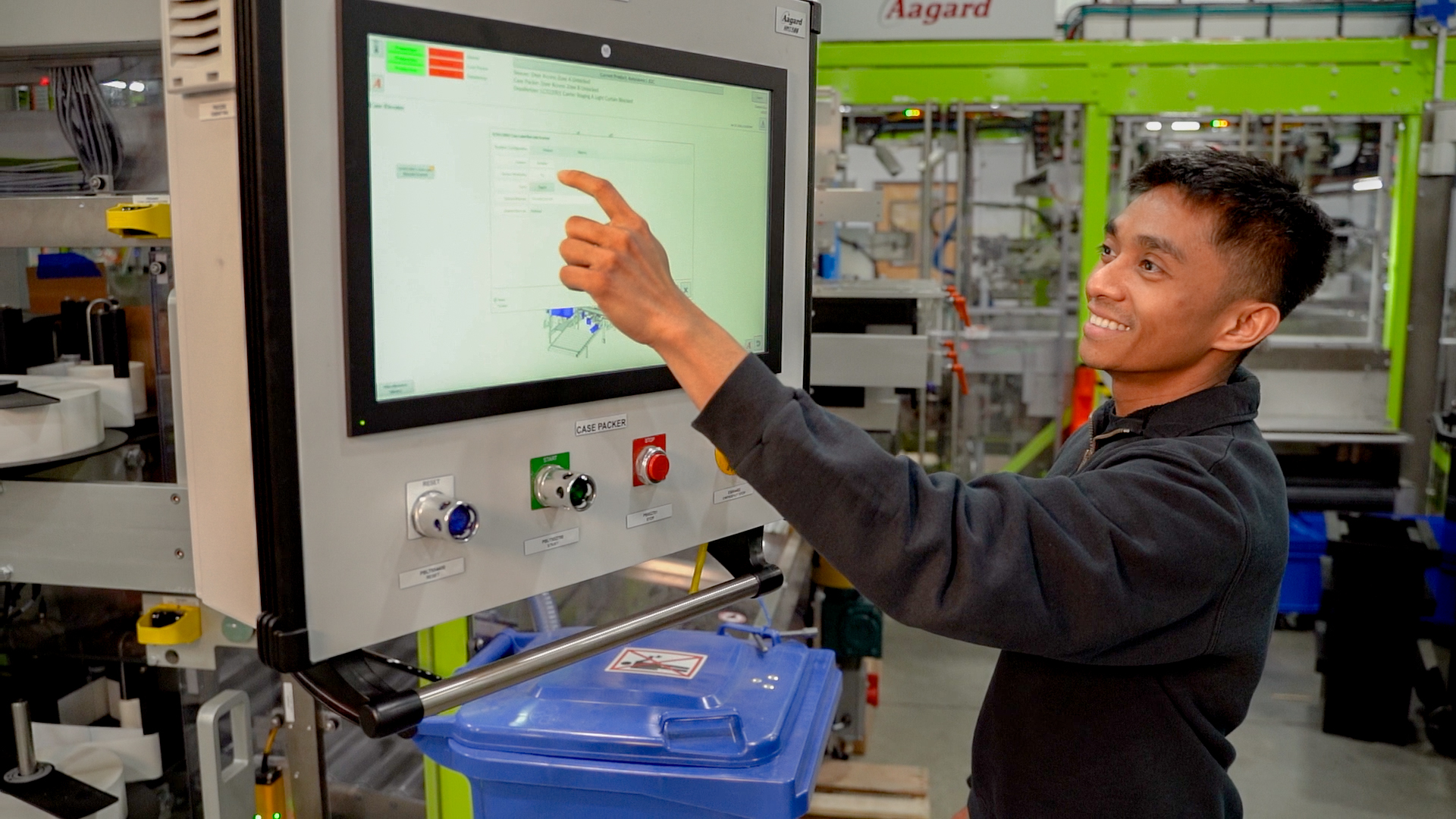
Those activities only create value because the process requires them. What if the process didn't? That question shaped nearly every engineering decision behind this operation. The objective wasn't to remove people from manufacturing. The objective was to automate repetitive, predictable activities so people could focus on work that requires human judgment, creativity, and experience.
- Instead of loading magazines, operators can optimize production.
- Instead of transporting materials, they can solve process challenges.
- Instead of replenishing inventory, they can improve throughput.
- Instead of responding to routine tasks, they can focus on continuous improvement.
That's where human expertise creates its greatest value. Although automation can eliminate the need for people, it doesn’t have to. It can elevate the value of the work they perform. In many ways, that's one of the most important outcomes of this project. The operation wasn't engineered to replace people. It was engineered to allow people to spend their time where they make the greatest impact.
When Throughput Changes the Equation
The operation is designed to support approximately 10,000–15,000 trays per hour, approaching a quarter million trays per day. At those production rates, routine manual intervention becomes increasingly difficult to sustain. Materials must arrive exactly when they're needed. Packaging components must remain available. Inventory must remain synchronized. Recovery must happen quickly.
Every subsystem must stay coordinated with the larger operation. At this scale, throughput begins to expose every inefficiency. Every unnecessary material movement. Every delay. Every manual replenishment. Every interruption. Every disconnected system.
Small inefficiencies that may seem insignificant at lower production volumes quickly become constraints on the entire operation. That's why highly automated operations require more than automated equipment. They require integrated decision-making.
At these production rates, automation becomes less about reducing labor and more about maintaining production continuity. The higher the throughput, the greater the need for coordinated material flow, intelligent controls, real-time inventory visibility, automated recovery strategies, and systems capable of adapting when operating conditions change. As production scales, the engineering challenge changes as well.
The question is no longer: How do we automate another machine?
The question becomes: How do we engineer an operation capable of sustaining continuous production?
That distinction fundamentally changes how an operation is designed.
The Most Interesting Part Isn't the Automation
The most interesting part isn't the automation. It's the philosophy behind it.
We didn't begin by asking: "How do we automate another process?" We started by asking: "Why does production stop in the first place?"
That question changed everything. It forced us to rethink:
- Material flow
- Inventory movement
- Material preparation
- Replenishment
- Verification
- Recovery
- Packaging automation
- Warehouse integration
- Controls architecture
It challenged us to think beyond individual machines and instead engineer an operation where every movement, every handoff, every verification point, and every recovery strategy contributed to the continuity of the entire system.
For more than a decade, Aagard has been developing the technologies, partnerships, engineering capabilities, and systems expertise required to make this possible.
This project didn't represent a single breakthrough. It represented the convergence of years of engineering experience across material handling, packaging automation, controls integration, inventory management, mobile robotics, recovery strategies, and end-of-line automation.
Individually, each capability solved a customer problem. Together, they created something significantly more powerful. An operation capable of functioning as one coordinated ecosystem. One designed to anticipate variability rather than simply react to it. One engineered to maintain production continuity even as conditions change.
Ultimately, that's what makes this project so compelling. It demonstrates that autonomous packaging isn't achieved by adding more automation. It's achieved by designing an operation where automation, information, material movement, recovery strategies, and intelligent controls work together as one integrated system.
When manufacturers begin asking why production stops—instead of simply asking how to automate another machine—they begin designing fundamentally different operations.
Operations that are more resilient. More adaptable. More visible. More connected.
And ultimately, more capable of sustaining continuous production. That's the opportunity that excites us most. Not because this project represents the end of what's possible. But because it demonstrates what's possible when engineering begins with the operation—not the equipment.
So perhaps the most important question isn't whether lights-out manufacturing is possible. We've shown that it is.
The better question is: If we can engineer out the reasons production stops...What becomes possible next?
Frequently Asked Questions
-
Is this truly a lights-out manufacturing operation?
The operation was designed so products can move from inbound materials to finished goods with minimal routine human interaction. Material preparation, delivery, packaging, verification, palletizing, inventory management, and recovery are coordinated through integrated automation and controls.
-
What problem was Aagard trying to solve?
The objective was not to automate one process. The objective was to systematically engineer out the reasons production stops, including material replenishment, inventory movement, manual handling, verification tasks, and routine production interventions.
-
What makes this different from a traditional automated packaging line?
Traditional automation often focuses on individual machines. This approach integrates warehouse systems, intelligent material preparation, AMRs, packaging automation, verification technologies, palletizing, recovery strategies, and intelligent controls into one coordinated operation.
-
How does the system keep production moving when something goes wrong?
The operation incorporates accumulation, buffering, redundancy, recovery pathways, intelligent controls, multiple packaging assets, and controlled material flow designed to prevent localized disruptions from becoming broader production stoppages.
-
Why were MiR and ROEQ technologies selected?
MiR autonomous mobile robots and ROEQ Lift & Roll technology support flexible material movement while reducing conveyor infrastructure, transfer points, and manual transportation requirements. Their established integration also supported implementation confidence and coordinated operation throughout the facility.
-
What role does traceability play in the operation?
The operation incorporates RFID management, barcode verification, integrated labeling, laser printing, pallet identification, and forensic cameras to improve visibility, traceability, validation, and troubleshooting throughout production.
-
Does lights-out manufacturing eliminate the need for operators?
No. The goal is to automate repetitive activities so skilled employees can focus on troubleshooting, optimization, diagnostics, problem solving, and continuous improvement.
-
What throughput can the system support?
The operation is designed to handle approximately 10,000–15,000 trays per hour, approaching a quarter million trays per day.
-
What was the biggest engineering challenge?
The challenge was designing an operation able to maintain production continuity despite variability, disruptions, material flow changes, and equipment issues. This required careful attention to recovery strategies, redundancy, traceability, system architecture, and failure-mode management.
-
Is this a single machine or a packaged solution?
This is an integrated approach assembled around a customer's operation. The value comes from how material preparation, AMRs, packaging automation, verification, recovery strategies, and end-of-line automation work together as one coordinated system.