If you’re in packaging right now, you’re managing more SKUs, more promotions, more seasonal runs, and more last-minute changes than ever before.
Variety may be great for customers—but on the production floor, it creates constant complexity.
That’s why flexibility has become one of the most important requirements in secondary packaging. Teams need systems that can adapt quickly, handle multiple product configurations, and move through changeovers without hours of downtime or piles of change parts.
Modular, flexible automation is stepping into that role—and changing what packaging lines are capable of.
Why Flexibility Matters More Than Ever
SKU Counts Keep Growing
Product variety isn’t slowing down. More flavors, sizes, configurations, seasonal products, and retailer-specific packaging all add complexity to the line.
For many manufacturers, product changeovers are no longer occasional events. They happen multiple times throughout the shift, putting pressure on both equipment and operators to keep pace without sacrificing efficiency.
Production Runs Are Shorter and More Fragmented
Long, uninterrupted production runs are becoming less common.
Instead, packaging teams are balancing a constant rotation of products throughout the day:
- A core SKU for a few hours
- A secondary product run
- A promotional or mixed bundle
- Then back to the original SKU to finish the shift
That kind of variability demands equipment that can pivot quickly without slowing down the rest of the operation.
Retail and Promotional Demands Require Agility
Retailers expect speed and flexibility—especially for variety packs, promotional runs, and private-label products.
For co-packers, this creates an almost constant rotation of new requirements. The ability to switch formats quickly and accurately becomes a major operational advantage.
Simpler Changeovers Are No Longer Optional
Labor challenges are reshaping packaging operations too. With fewer highly experienced operators available, systems can’t depend on tribal knowledge or complicated manual adjustments.
Modern packaging equipment needs to guide the process and reduce the chance of operator error.
That’s why newer systems prioritize:
- Tool-less or minimal-tool adjustments
- Digital recipes that eliminate guesswork
- Interfaces that guide operators step-by-step through changeovers
The goal is simple: make flexibility easier to execute consistently.
What Makes a Packaging System Truly Flexible?
Changeovers That Don’t Slow Production
Flexibility starts with how quickly a system can move from one product to the next.
Older equipment often required extensive manual adjustments, tools, and trial-and-error setup. Today’s systems are designed to simplify that process so operators can make changes quickly and confidently.
That often includes:
- Quick-adjust rails and lanes
- Hand dials with calibrated indicators
- Clamp systems for repeatable positioning
- Clearly marked adjustment points
The objective isn’t just faster changeovers—it’s repeatable results every time, regardless of who’s running the machine.
Digital Recipes Reduce Complexity
One of the biggest shifts in flexible automation is the move from manual setup to recipe-driven controls.
Instead of relying on handwritten notes or operator memory, systems store product configurations digitally. With a single selection, the machine can automatically adjust key parameters across the line.
That may include:
- Guide rail positioning
- Sensor settings
- Pack patterns and product counts
- Robotic movement paths
- Product handling configurations
This reduces setup time while improving consistency and accuracy across shifts.
Modular Systems That Evolve Over Time
Flexibility isn’t only about faster changeovers—it’s also about adapting as operations grow.
Modular system architecture allows manufacturers to expand or reconfigure equipment without replacing the entire line. New capabilities can be added as production needs change.
That approach supports:
- Faster response to new product launches
- Easier integration of new technologies
- Reduced long-term capital disruption
- Scalability without starting over
One System, Multiple Capabilities
Highly flexible systems are designed to manage multiple product formats within the same footprint.
That might include:
- Single-SKU products
- Multi-flavor variety packs
- Different count configurations
- Multiple packaging styles like cartons, trays, or wraps
The more versatility a single system can provide, the more value it delivers—especially in high-mix production environments.
How Aagard Designs for Flexibility
At Aagard, flexibility isn’t treated as an add-on feature. It’s built into the system from the start with the understanding that production needs will continue to evolve.
Modular Systems Built Around Real Production Needs
Aagard systems are designed as integrated modules that operate together through a unified controls platform.
Depending on the application, systems may combine:
- Cartoning and case packing
- Variety pack collation
- Vision inspection and verification
- Labeling or sleeving
- Palletizing and downstream handling
Because the modules communicate through a single controls system, operators experience a more streamlined workflow with less complexity.
Rapid Launch™ Changeover Technology
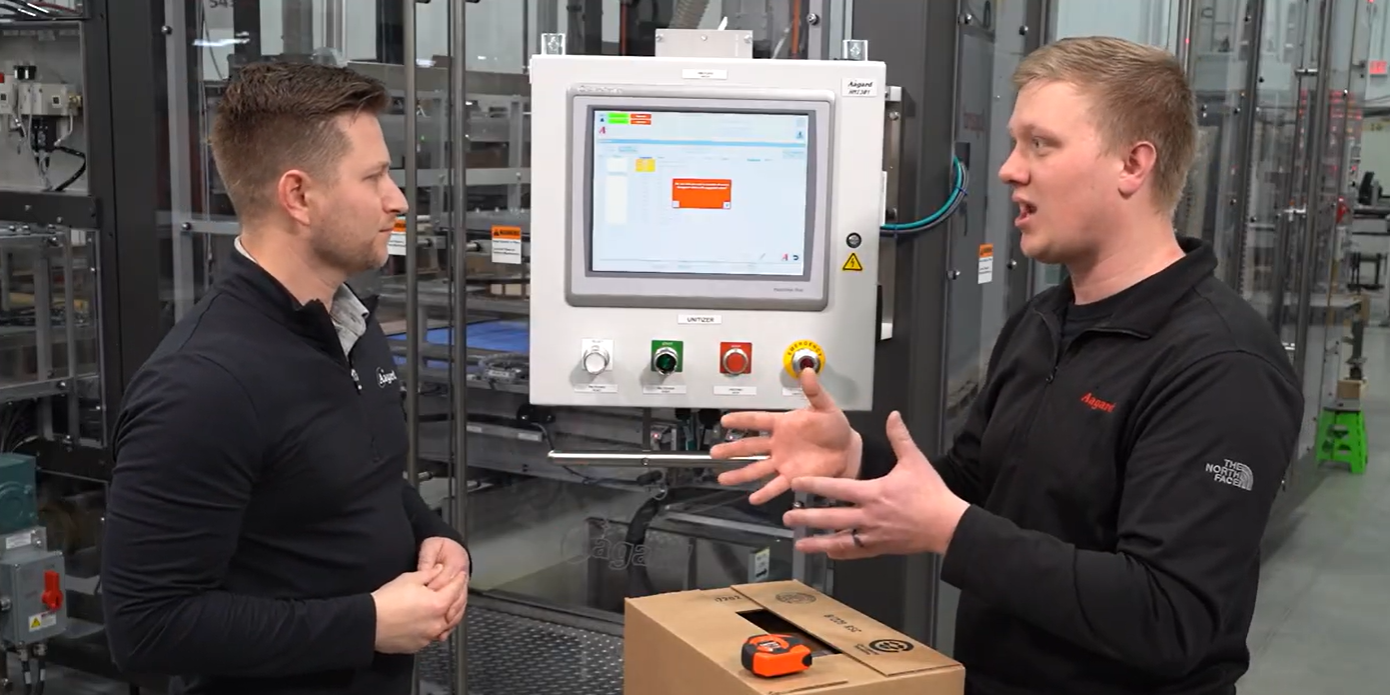
Rapid Launch™ was developed to simplify one of the biggest operational pain points: changeovers.
Operators can switch between products in minutes using guided instructions and preconfigured settings. In many cases, no programming is required—and for some products, no physical change parts are needed at all.
The result is a process that feels faster, more predictable, and significantly less stressful on the production floor.
Built for High-Mix Production Environments
Aagard systems are designed to handle production complexity at scale.
That includes managing:
- Multiple product streams
- Different product sizes and shapes
- Varying infeed speeds
- Precise product sequencing and collation
Products can be buffered, organized, and released in exact combinations, allowing manufacturers to run variety packs and mixed configurations without disrupting throughput.

Real-World Example: Multi-Flavor Variety Packs
In one application, a manufacturer needed to manage a constantly changing mix of flavors while maintaining strict accuracy requirements.
The solution combined:
- Multi-lane accumulation
- Automated product mapping
- Servo-driven adjustments
- Built-in verification systems
Operators simply select the required configuration, and the system manages the adjustments automatically—ensuring the correct product mix every time.
The Real Competitive Advantage of Flexibility
Flexible automation doesn’t just make packaging operations easier. It creates opportunities.
With the right systems in place, manufacturers can:
- Respond to market trends faster
- Introduce new SKUs with less disruption
- Run smaller batches more profitably
- Switch between products without sacrificing throughput
- Consolidate multiple functions into a single system
In today’s market, where change is constant and production demands shift quickly, flexibility is no longer just a convenience.
It’s a competitive advantage.
And increasingly, it’s what separates packaging operations that can adapt quickly from those struggling to keep up.
%20(4%20x%202.5%20in)%20(1).gif)